

Products Organic Agricultural Inputs - For Disease Management
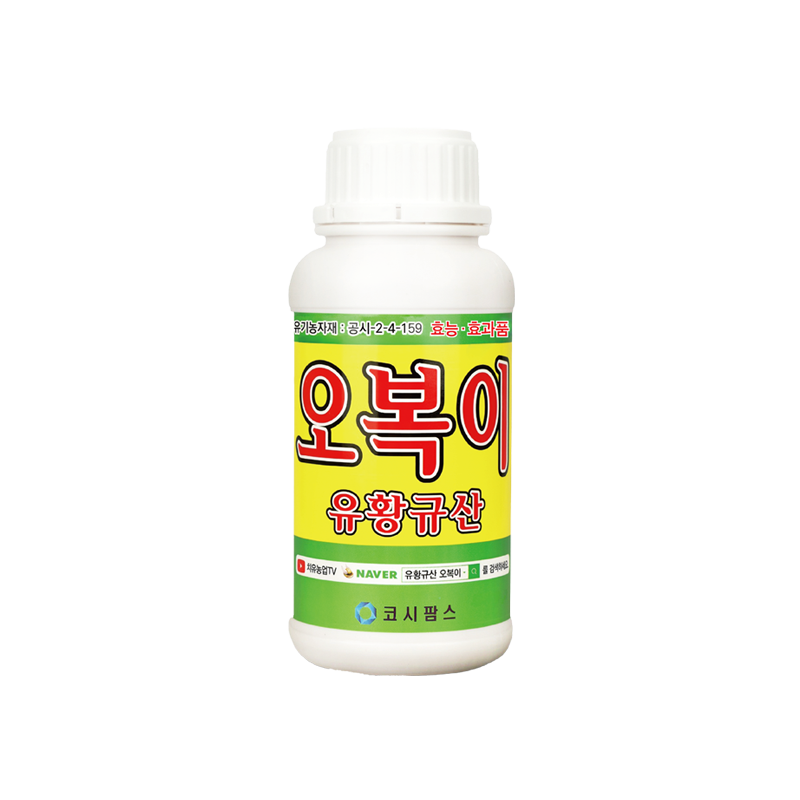
OBOKI
Penetrative sulfur-silicic acid
Agricultural Input Labeling InformationPatents: No. 10-2143300 and No. 10-2143302
| Public Notice No. | Gongsi-2-4-159 |
| Category | Disease Management |
| Brand Name | OBOKI |
| Type of Active Ingredients | 3.4% water-soluble silicic acid, 1.8% total sulfur content |
| Type and Input Ratio of Raw Materials or Ingredients | 10% sodium silicate, 2.3% sulfur, 87.7% auxiliaries |
Efficacy of Main Active Ingredients
Sulfur (S)
Fungicidal action
- Exhibits strong selectivity against pathogens with high lipid content, as sulfur is lipophilic.
- Penetrates pathogen cells effectively, entering fungal cells and affecting cellular respiration.
- Increases resistance substances on leaf surfaces through soil drenching with sulfur, suppressing the spread of fungal diseases.
Insecticidal action
- Causes paralysis of normal biological functions in insects through direct contact with and ingestion of sulfur.
- Inhibits energy metabolism within insects, resulting in strong acaricidal action.
Silicic Acid
- Strengthens the plant cell outer wall (double silica layer), increasing resistance and immunity to external stress.
- Helps prevent pests and diseases; mitigates frost damage; reduces low- and high-temperature stress, excess moisture stress, and fruit drop.
- Promotes photosynthesis, accelerates silicification of epidermal cells, and reduces weather-related damage.
Root Development and
Growth Promotion
Root Enlargement
Yield Increase
Sugar Content Increase
Pest and Disease Prevention
Prevention of Freezing, Cold, and Drought damage
Lodging Prevention
Tissue Strengthening
Improved storability
Prevention of excessive vegetative growth
No phytotoxicity or residue marks
Product Features
- Produces robust crops.
- Enables the production of high-functional agricultural products containing sulfur and silicon.
- Applies to all crops and supports root development and crop growth.
- Achieves 100% absorption by crops, eliminating the need for penetrants and spreaders.
- Provides cost-effective control by helping prevent various diseases.
- Reduces pesticide use through sterilizing and disinfecting action.
- Shows no phase separation or clumping and causes no phytotoxicity, residue marks, or soil acidification.
- Remains compatible with all fertilization methods and causes no nozzle clogging or abrasion.
- Prevents cold and drought damage.
- Raises no concerns regarding the PLS (Positive List System).
How to UseAdjust application rates according to crop condition.
| Applicable Crops | Application Rate |
| Grasses (Poaceae), leafy vegetables, fruit vegetables, root vegetables, fruit trees, ginseng, turfgrass | Mix 20–40 mL per 20 L of water (half cap = 20 mL, 1,000× dilution) and spray. |
| Apply 2–3 times per month (at 10–14 day intervals). | |
| When disease occurs, mix with a registered pesticide and spray 2–3 times at 3–4 day intervals. |
Clear Filters

SELMAGEU
Fertilizers – Micronutrient Compound Fertilizers
SIWONI
Fertilizers – Micronutrient Compound Fertilizers
OBOKI
Organic Agricultural Inputs – For Disease Management
OBOKI PLUS
Organic Agricultural Inputs – For Disease Management
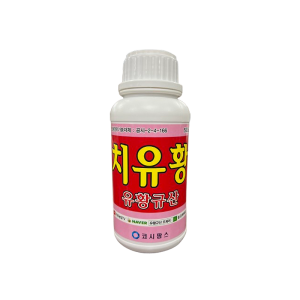
CHIYU HWANG
Organic Agricultural Inputs – For Disease Management
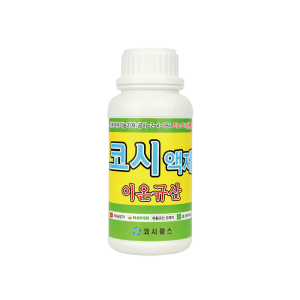
KOSI SL
Organic Agricultural Inputs – For Disease Management
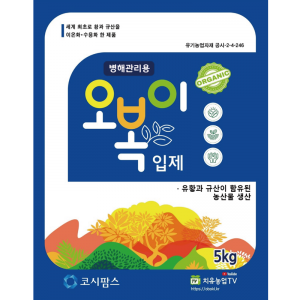
OBOKI GR
Organic Agricultural Inputs – For Disease Management